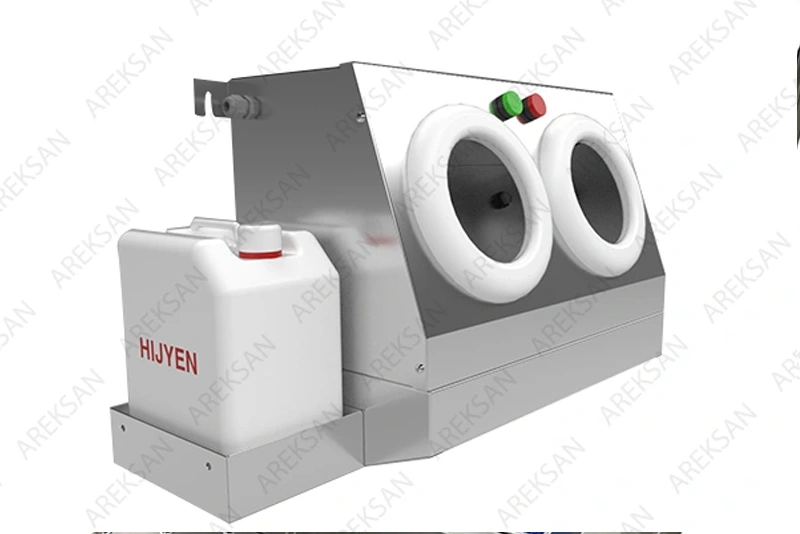

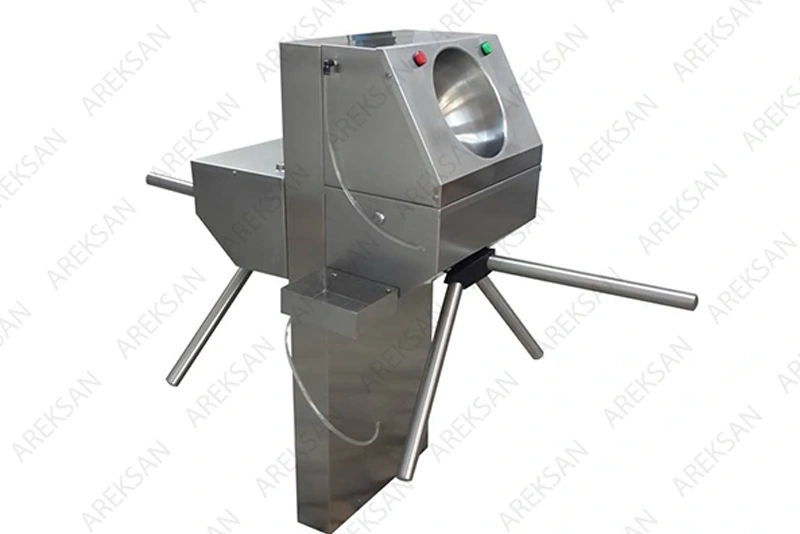
The Areksan HJT-2 is a floor-mounted hygiene corridor with independent entry and exit turnstile control, engineered to enforce mandatory hand disinfection at both directions of personnel passage. The disinfection unit at the entry point delivers 3–5 ml of disinfectant to both hands simultaneously in a single automated cycle. The turnstile mechanism will not grant passage in either direction until the disinfection requirement has been met, establishing bidirectional hygiene control at every personnel transit event. Overall dimensions are 85 × 1645 × 1350 mm, operating weight is 79 kg, and the enclosure is fabricated from 1.5 mm 304-grade stainless steel.
Floor-Mounted Bidirectional Turnstile System Enforcing Hand Disinfection at Entry and Exit Points
Dual-Direction Turnstile Control with Mandatory Hand Disinfection
The HJT-2 deploys independent turnstile control at both entry and exit points of the hygiene corridor, making hand disinfection a mandatory procedural requirement in both directions of personnel flow. The entry disinfection unit automatically delivers 3–5 ml of disinfectant to both hands in a single touchless cycle. Neither the entry nor the exit turnstile will release until the disinfection sequence assigned to that direction has been completed, structurally preventing any bypass of the hygiene protocol regardless of traffic volume or shift changeover pressure.
Floor-Mounted Design for High-Traffic Passage Points
The HJT-2 is engineered as a floor-mounted, self-contained unit that does not require wall anchoring or structural modification of the surrounding environment. This installation approach makes the system suitable for open production floor layouts, wide entry corridors, and facilities where wall-mounted solutions are not compatible with the existing infrastructure. The unit’s longitudinal form factor — optimized for controlled single-file personnel flow — ensures that both entry and exit hygiene steps are completed in sequence without creating bottlenecks at high-traffic access points.
Durable Construction and Modular Turnstile Design
The HJT-2 enclosure is fabricated from 1.5 mm thick 304-grade stainless steel, providing high resistance to external environmental conditions, moisture, chemical disinfectants, and the demands of intensive industrial use. Turnstile arms are modular in construction and can be removed and reinstalled individually without specialized tooling, enabling routine maintenance and deep cleaning to be carried out efficiently without interrupting operational continuity.
Access Control System Compatibility
The HJT-2 operates in full compatibility with access control systems and token readers. The system is controllable via dry contact inputs, TTL and CMOS signal protocols, and supply voltages across the 5–48 V range, enabling direct integration into existing entry and exit management infrastructure without additional interface hardware. Operating voltage is field-configurable at 110/220 V – 60/50 Hz AC (±10%) or 24 V DC.
Technical Specifications
- Model No.: HJT-2
- Dimensions: 85 × 1645 × 1350 mm
- Weight: 79 kg
- Material: 1.5 mm 304-Grade Stainless Steel
- Hand Disinfection: Touchless, simultaneous 3–5 ml disinfectant delivery to both hands
- Turnstile Configuration: Bidirectional — independent entry and exit turnstile control
- Mounting: Floor mounted
- Operating Voltage: 110/220 V – 60/50 Hz AC (±10%) / 24 V DC
- Power Consumption: Standby ~11 W / Active Passage ~60 W
- Signal Compatibility: 5–48 V Dry Contact, TTL / CMOS
- Integration: Access control systems, token readers, card-based entry systems
Typical Applications
The HJT-2 bidirectional hand disinfection turnstile is deployed in centralized food production facilities, large-scale catering operations, pharmaceutical manufacturing plants, and institutional environments where hygiene compliance must be enforced at both entry and exit points of the production area. By controlling personnel hygiene in both directions of passage, the HJT-2 provides a higher level of contamination risk management than single-direction systems — making it the preferred specification for high-throughput environments where personnel flow is continuous and bidirectional hygiene accountability is operationally critical.